Exploring the promises and pitfalls of disclosures when audiences feel ‘iffy’ about GenAI
By Janet Heard, CINIA Communications Practitioner
Journalists are confronted with a “disclosure paradox” when it comes to the use of Generative AI.
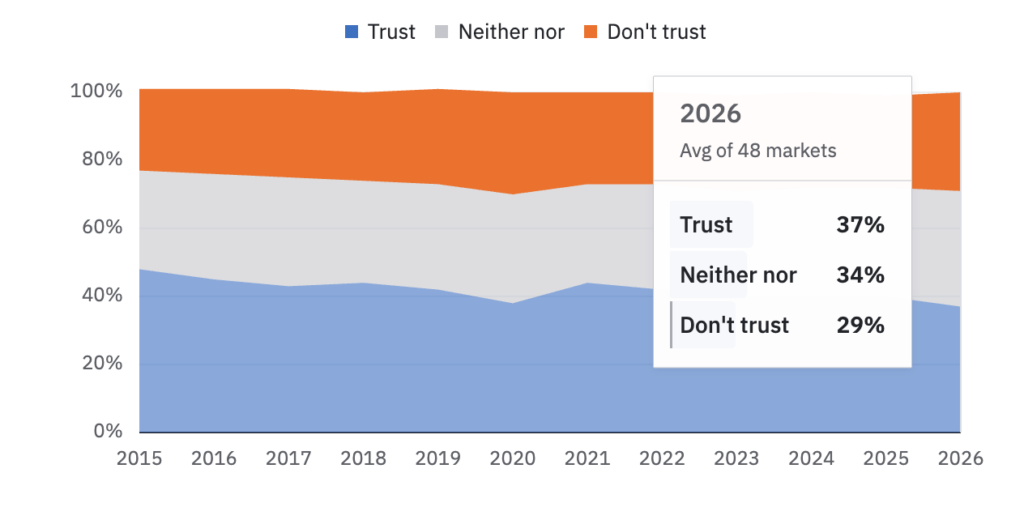
This creates an additional hurdle in the struggle for sustainability amid a growing trust deficit, as starkly evidenced in the latest 2026 Reuters Digital News Report.
The tricky navigation of disclosure is explored in a new research study: Feeling Iffy About Generative AI: Investigating Audiences’ Trustworthiness Perceptions of Task-Specific AI disclosures. The Dutch-based study, to be published in Digital Journalism, was presented by co-author and social scientist Kimon Kieslich at the International Communication Association (ICA) preconference in Cape Town in June.
The study documents earlier findings that revealed that journalistic AI disclosures often compromise rather than facilitate trust and credibility perceptions of news.
A recent Nieman Lab report explored this dilemma and looked at research that offered suggestions on ways that news organisations could label their AI use for audiences.
Picking up the conversation, Kieslich reminded ICA participants that transparency and disclosure are non-negotiable, core trustworthy values embedded within press codes across the globe.
Newsrooms currently favoured a dual approach: attempting to be transparent about AI labelling within their workflows, while simultaneously emphasising human oversight.
However, the Dutch-based study warned that a broad, one-size-fits-all disclosure strategy may backfire on newsrooms. Instead of boosting credibility, a blunt approach may reduce public trust.
“The problem is that the ambition to be transparent does not match audience expectations,” Kieslich explained in a follow-up interview. In fact, the high level of mistrust for GenAI meant that audiences viewed its association with fact-based, ethical journalism as a “mismatch”, especially when it came to specific tasks such as fact-checking.
Newsrooms, therefore, need to think carefully about AI disclosures and consider carefully how best to implement them.
This approach is a key recommendation of the study, which was based on an experiment that included 683 respondents who were representative of the Dutch population in terms of age, gender and education.
The study was co-authored by Nicolas Mattis and Claes de Vreese via an affiliation with the AI, Media & Democracy Lab at the University of Amsterdam.
Their research noted that disclosure labels often “do not do justice to how journalists actually aim to use GenAI”. They referred to earlier studies that showed that AI labellings are predominantly interpreted as complete automation, which is usually not the case.
The researchers set out to explore the effects of more nuanced AI disclosures that better reflect how journalists integrated GenAI into their workflows.
The experiment probed tasks throughout the journalistic value chain — spanning the news gathering, production, and verification stages — where AI could play an operational role. It specifically explored the direct effects on public trustworthiness when disclosing that these tasks were performed by an AI, rather than a human. The tasks were idea-generation; generating/selecting images; background research; article writing; proofreading; and fact-checking.
A seventh distinct category was monitored, labelled “Human-in-the-loop” – to track responses to disclosures that human oversight was involved throughout the news production process.
The overarching outcome was stark: all task-specific AI disclosures had a significant negative effect on the perceived trustworthiness of news. The researchers also found that these trust penalties varied notably between tasks and across individuals, though they did not vary between different news topics.

Kimon Kieslich
Kieslich noted that an elementary question for the industry was how to convey to their audiences that some use of GenAI was helpful to do specific tasks — particularly in the field of investigative journalism, where AI can perform data tasks that strengthen outcomes — but that human journalists remain fully responsible.
“But the baseline AI disclosure may not be the right direction. It needs to be nuanced to get the message across and to build trust. Importantly, it does not mean that AI disclosure is bad. It means that newsrooms must be careful about how they communicate it. There needs to be a very specific way of doing that.”
Disclosures for tasks that fall into earlier stages of the news value chain, namely image and idea generation, had noticeably smaller trust penalties than those for tasks related to news production, with fact-checking being perceived as particularly problematic.
The report noted: “This variation, which remains consistent across several news topics, could suggest that readers consciously differentiate between different AI use cases when making trustworthiness judgments, i.e., some tasks are experiencing stronger trust penalties than others.
“Another important and potentially concerning insight is that lower levels of concern about GenAI usage are particularly prominent among respondents who know relatively little about how journalists actually use GenAI. This finding reinforces an urgent need to invest in news media literacy initiatives that help people understand and critically assess (journalistic) information”.
The gist, explained Kieslich, was that disclosures needed to find a balance – of not overloading readers with dense technical information, but explaining policies in a simple manner that enabled audiences to understand the responsible use of GenAI.
Newsrooms needed to consider more carefully what to include in position statements on the use of GenAI in editorial policies, and when to reference specific article-level task disclosures.
He suggested that newsrooms interact with their audiences – through surveys and the like – to determine their needs, interests and level of understanding of AI, and then respond accordingly.
Ultimately, maintaining public credibility relied on preserving the foundational connection between the reporter and the reader. Kieslich suggested treading cautiously with the core tasks of journalism that build trust with audiences. “Don’t forget the human element of journalism – of understanding the world. That is a key task of journalism. If that is taken away, that is when people get iffy.”
The Generative AI in the Newsroom (GAIN) project explores these issues further. Access the blog here.