Watch out for mock-up ballot papers online and other manipulations as the poll date nears
 By Yossabel Chetty, CINIA Researcher.
Date Range: 01/08/2026 – 31/08/2026
This report investigates three concerning vectors relating to information integrity that are currently shaping the digital electoral environment. The first vector explored is vote-rigging claims that may be primed through the pre-election circulation of mock-up ballot papers online, and also outlandish demands by smaller political formations for the IEC to elevate security at voting booths.
The second vector is the weaponisation of xenophobic rhetoric, with analysis of how anti-immigrant sentiment is being used to manipulate perceptions and obscure coalition policy realities in key metros.
The third vector is disaster relief, and we look at how images of assistance given to residents in Buffalo City were misrepresented days later.
By identifying and mapping these online dynamics, this report aims to provide a clearer understanding of how digital platforms are being used to disrupt democratic processes and manipulate voter perceptions ahead of the November 4 polls.
1. Priming the “stolen election” narrative
Imitation ballot papers for the 2026 Local Government Elections (LGE 2026) have begun circulating across platforms. The first example was found in a response to an MK Party post that announced its mayoral candidates for Mangaung, Buffalo City and Johannesburg municipalities.
The image shows a ballot paper marked with a vote for the ANC. An image search returned a few other examples. Images of the ballot with a cross for the MK Party were also found.
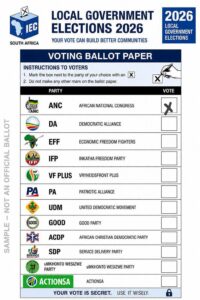
While the ballot images contain the words “Sample – not an official ballot paper” in light gray lettering, there are discrepancies with the samples on the IEC website. The imitation ballot displays “Local Government Elections 2026”. Legitimate IEC sample ballots feature heavy “Sample” watermarks and bold lettering across the top stating “Sample Ballot Paper”. The IEC also provides generic placeholder names (such as gems and precious stones) and omits election years and party names.
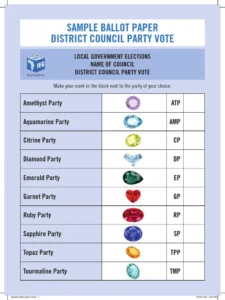
The circulation of unapproved modified digital ballots risks confusing voters and fuelling later vote- rigging narratives. The light gray disclaimer provides plausible deniability to avoid legal trouble while remaining faint enough to be overlooked by scrollers who may assume the image is authentic. The creation of images like this requires digital capability and intent.
Alongside the digital ballot discussions, institutional challenges to the electoral process have emerged. The Truth and Solidarity Movement (via @AFRICANDEMOC) issued demands for the IEC to enact amendments to the Electoral Act.
This account regularly posts conspiratorial content and unverified claims. Most recently, it claimed that March and March leader Jacinta Ngobese-Zuma is a “Mossad agent from Mozambique”. With a very right-wing, imperial outlook, the party president says it aims to defeat the “Woke/Bela Bill”, “Bill Gates Agricultural Programs” and “Farm Murders”.
However, the person who appears as the President of the movement, Mehmet Vefa Dag, does not appear to be the person who penned the list of demands. The author of the Truth and Solidarity Movement’s Draft submission in the social media post by @AFRICANDEMOC is identified as “Farouk Mowzer Head of Truth and Solidarity Movement” on the post. According to the People’s Assembly website, he was the 10th candidate for the MK Party in the Western Cape in 2024, where he still appears as a member. His name does not appear on the recently updated members page of the movement.
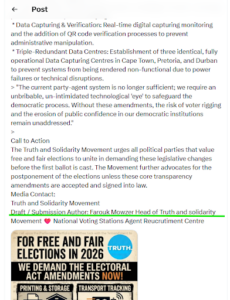
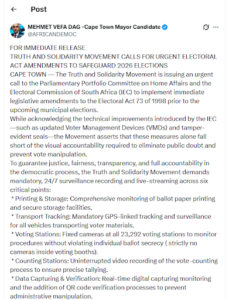
Directing conspiratorial rhetoric at the IEC, Mowzer, according to Dag’s post, asserts that measures already taken to improve voting stations are inadequate. Its demands include 24/7 cameras at more than 23 000 booths and establishing three identical data-capturing centres in Cape Town. The cost and feasibility of these demands were called into question in the comments, especially with so little time before election day.
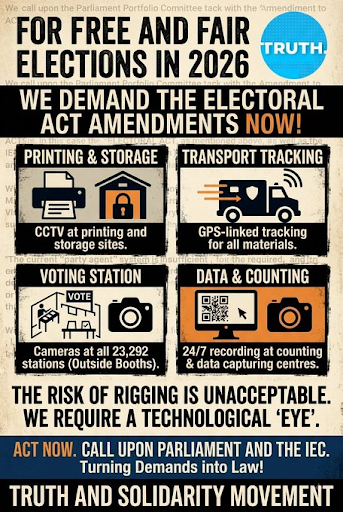
The association with the MK Party is a red flag because the party alleged vote-rigging after the national elections, for which the court reserved judgment in June 2026 until all evidence is carefully examined. The IEC and election analysts have noted that no expert testimony or material evidence was provided by the MK Party to support its claims.
These campaigns create fear and paranoia about fair election processes and diminish trust in democratic institutions like the IEC. This is also a convenient narrative to use as an excuse, should election outcomes not be in favour of these actors. TSM should therefore clarify Mowzer’s role as the Head of The Solidarity Movement and if he still has any ties with the MK Party.
2. Xenophobia, disconnects and questionable amplification
Anti-immigrant messaging has resurfaced as a campaign strategy for a few parties across several municipalities. In Cape Town, DA Mayor Geordin Hill-Lewis published video content on TikTok showcasing municipal enforcement operations. While targeting illegal businesses, undocumented foreign nationals are explicitly mentioned. Law enforcement initiatives in the Western Cape that target migrants were contested at the end of August 2026 by the Western Cape Coalition Against Xenophobia (WCC-AX) which claimed that even those African foreigners who are in the country legally are being detained in deplorable conditions for up to two months.
The announcement of the EFF mayoral candidate (Sinawo Tambo) in Nelson Mandela Bay, and other posts by the party in August, were often hijacked by anti-immigrant sentiment in the comments. Accounts that were commenting across multiple posts frequently referenced what appears to be a section of the EFF’s manifesto that displays its support for migrants in South Africa.
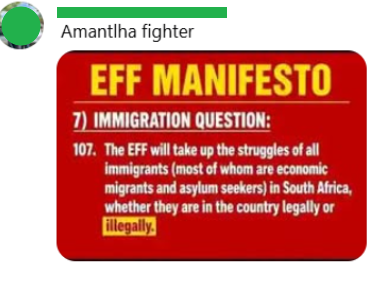
This national stance contrasts sharply to the reality at municipality level. In the Alfred Duma Local Municipality (Ladysmith), the EFF is a member of the IFP-led coalition, with its councillor serving as Chair of the Public Safety and Emergency Services Portfolio Committee.
Many foreign-owned businesses were closed down by the municipality in the last few months. After a successful challenge by business owners, the shops were lawfully reopened at the end of August. This calls into question the role of councillors and how actions at ward level are not in accordance with national manifestos.
In Durban, Action SA leader Herman Mashaba published a widely shared video featuring Jacinta Ngobese-Zuma endorsing his pick for mayoral candidate. Ngobese-Zuma is not an elected political official, but her endorsement appears to carry significant digital weight, as seen by the thousands of likes and comments generated.
However, much like the accounts that were flagged under the Build One SA (BOSA) campaign in our report on July trends, many comments from accounts that drive positive messaging about Ngobese-Zuma have the label “digital creator”. This title is applied to profiles in professional mode on Facebook. Professional mode offers access to tools such as monetisation and content insights. Further, when you click on these accounts, Meta lists them as an advertiser, for transparency. The authenticity of amplification by digital creators is called into question as they try to balance posts with commercial interests.
Another controversial account that drives anti-foreigner content and unverified claims, @joy_zelda, has taken an interest in eThekwini and ActionSA. A post encouraged people to give ActionSA a chance because “MK party failed the many who gave them a chance”. This account, with more than 68 000 followers, is fiercely pro Ngobese-Zuma and anti EFF.
3. Decontextualised Content
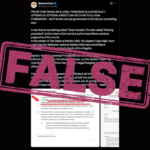
Disaster relief efforts in Buffalo City were misrepresented on X and Facebook. Imagery showing the distribution of timber and corrugated iron sheets to victims of recent storms was stripped of context. The image was recirculated with claims that the ANC was distributing shack materials in Gqeberha on 20 August and again on 22 August 2026. Earlier, on 17 August 2026, the same images were shared by the Buffalo City Municipality to show assistance given to people who lost their homes from storm-related damage.
There are similar images that show disaster relief efforts across the country over the years. It is not uncommon for municipalities to provide iron sheets and timber to local residents to reduce the impact of storms (a tip: look for an example of the other posts – consider the municipality they are in, the year, and which party is/was governing).
This tactic leverages genuine municipal interventions and detaches images from their original geographical and situational context (also known as decontextualised content). Images are reframed to imply illicit voter patronage or state-sponsored informal settlement expansion ahead of the polls.