Navigating South Africa’s 2026 election narrative
The road to South Africa’s November 4 local government elections is being paved with more than just posters and rallies. It is being constructed through a complex, often invisible, digital architecture. As the IEC (Electoral Commission of South Africa) prepares for what they describe as a “category 5 hurricane” of disinformation, the traditional boundaries of political campaigning have dissolved into a high-stakes influence-for-hire economy.
For those monitoring the integrity of our information ecosystem, the recent surge in automated and coordinated inauthentic behaviour presents a dual challenge: protecting the agency of the voter while preserving the sanctity of democratic institutions.
Speaking to CINIA’s Janet Heard, IEC Deputy CEO Victor Shale recently acknowledged that the commission is always behind the speed of unfolding disinformation. This isn’t merely a technological gap. The 2024 general elections proved that previous safeguards are no longer sufficient. Peddlers of falsehoods are now financially incentivised to create crises, operating within an informal media economy that bypasses traditional political funding disclosures.
When anonymous influencers are paid to shift narratives, accountability vanishes. The IEC notes that without a transparent regime for online spending, the public is often left blind to who is actually funding the viral moments on their feeds.
The Curiosity of “Oom Piet”
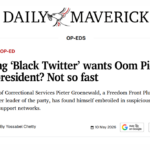
CINIA researcher, Yossabel Chetty, unpacked the question of influencer authenticity with political candidates. A prime case study in this shifting landscape is the recent online phenomenon surrounding Minister of Correctional Services, Pieter Groenewald. Emerging from the Freedom Front Plus, “Oom Piet” has become an unlikely darling of segments of “Black Twitter.” While some support appears organic, researchers have identified suspicious clusters of activity.

Mega-influencers, some with millions of followers, have been seen blurring the lines between satire and political promotion. The danger here is twofold:
- Monetisation of Trends: Inauthentic actors monitor what resonates with the public to drive clicks and views, regardless of the political truth.
- Manufactured Consent: By flooding the ecosystem with specific narratives, these actors can create a false sense of overwhelming support, influencing the undecided voter through perceived popularity.
Protecting the Information Ecosystem
The IEC’s data suggests that while social media is the battlefield, citizens still place the highest trust in traditional television and community radio. This trust gap is where the defence must be built. The commission is pivoting toward these credible channels to verify information and counter the democratic recession fuelled by populism.
As we move closer to November, the responsibility does not rest solely with the IEC. It requires:
- Political Leadership: Moving away from politics as wealth accumulation and toward development-focused, positive messaging.
- Voter Vigilance: Transitioning from passive consumers to active verifiers of the content we encounter.
- Platform Transparency: Holding digital giants accountable for the “influencer-for-hire” economy that dictates modern discourse.
The health of our local democracy depends on our ability to see through the digital fog. Disinformation thrives in the shadows of anonymity and financial greed. The best defence is the voter who engages with content online critically and who verifies before sharing.
*This newsletter originally appeared on LinkedIn. You can subscribe to receive CINIA’s newsletter straight to your inbox, via LinkedIn, HERE.