

From a 20-hour hackathon to an online counter-campaign – how civil society clapped back at xenophobia
By Yossabel Chetty, CINIA Researcher
While divisive voices online whipped up mass hysteria with an unofficial deadline for undocumented foreigners to leave South Africa by 30 June 2026, civil society groups and individual citizens responded by generating a social media storm to disrupt xenophobic narratives.
Counter X, a media amplification group run by Mobilize, was born from a 20-hour hackathon on Saturday, 27 June 2026, hosted by Campaign on Digital Ethics (CODE), Moxii Africa, Campaign for Free Expression, the Ahmed Kathrada Foundation and Justice and Activism Hub.
“Our voices are being drowned out by a loud, organised campaign of fear — and a lot of it isn’t even real people. It’s bots, built to make hate look bigger than it is,” Counter X states on its web page.
Partnering with anti-xenophobia groups that included Siyafana Sonke (“We are all the Same”), Counter X attracted roughly 800 participants between Monday evening and Tuesday night, all donating their time and social media access for a cause they believed in.
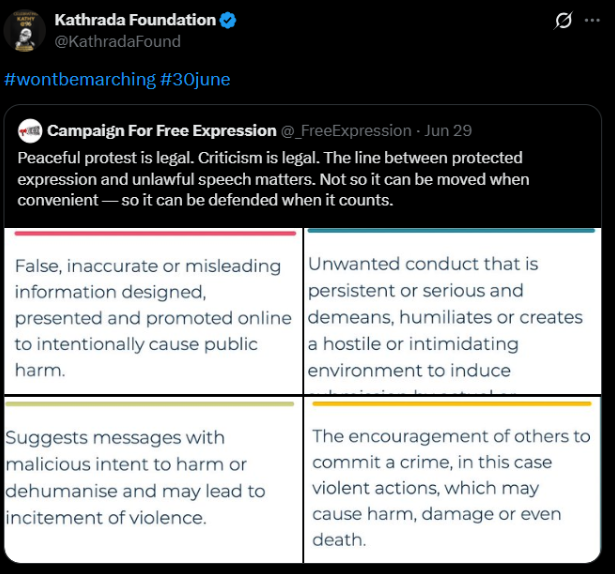
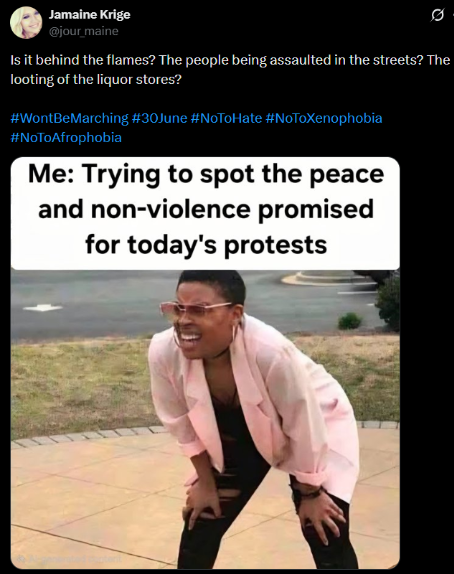
In addition to the coordinated media amplification campaign, many activists and civil society groups used their voices and influence individually on social media to counter narratives circulating about South Africans and migrants.
A social media storm leverages the scale and algorithms of platforms to place content on the newsfeed, homefeed or “for you” page of platform users. It works in much the same way that a standard amplification campaign works. However, there is more transparency and no financial benefit for participants.
Explaining the distinction between bot farms and the work of Counter X, David Lydall and Khanya Peacock from Mobilize, said it was like a rent-a-crowd versus authentic mobilisation.
About 800 volunteers self-organised to counter rising tensions in the country that had been triggered by the June 30 deadline campaign, and which appears to have been escalated amid considerable financial backing.
Both Peacock and Lydall see this first counter-xenophobia movement as a seeding round to help more volunteers find a space to get involved in both online and on-the-ground activities.
It appealed to South Africans who were angered at the rise in hostility and hate toward African foreigners and who wanted to get involved to set the record straight and build bridges, but were unsure how to get involved.
Another key difference between the efforts of a counter campaign like the social media storm, compared to campaigns that are amplified through paid influencer networks, is that participants in a storm have the autonomy to amplify the content that they align with. People are not paid for the number of likes, comments and posts that they generate, so there is no need to compromise their beliefs by amplifying messages that contain content they might not support for a financial incentive.
In the opaque paid influencer space, we have seen how people forego their beliefs and political alignment in order to monetise from the social media marketing machinery.
When researchers at Murmur Intelligence, who have been analysing the South African political discourse for years, noticed a counter-campaign developing, they tracked the metrics of both the anti-foreigner and the anti-xenophobic campaigns.
Explicit counter-campaign terms such as #wontbemarching, #NoToHate #30JuneDeadline were used while march mobilisation terms like Abahambe, March and March and Operation Dudula were used to track the online march campaigns.
Over 48 hours, they tracked that the combined efforts of the counter-campaign performed just shy of 10% of the march campaign in terms of unique authors. When you consider the lucrative online influence that has been driving the march campaign and the timeframe for mobilising the counter campaign, this 10% figure highlights the potential for disruption by self-organising structures.
According to Murmur’s Aldu Cornelissen, the march campaign was more efficient per author as each author had an 18% higher reach and 19% higher impressions. This suggests that the march campaign had more posting intensity per contributor.
However, the counter campaign was more efficient per post than the march campaign: about 51% higher reach and 49% higher impressions.
Counter X plans to continue mobilising citizens who have access to data and social media channels and who wish to hold the government to account and level the toxic playing field online. The hackathon demonstrated that campaigns can be driven without a bureaucratic impediment.
March and March leaders who push “citizen-first advocacy” have announced they will continue their campaign against anti-undocumented immigrants for the next six months, noticeably coinciding with the November 4 local government elections. “Every Thursday, for the next six months, we are marching until they [undocumented immigrants] are gone,” March and March founder and leader Jacinta Ngobese-Zuma told thousands of protesters outside Point Police Station in Durban on Tuesday, as reported by Daily Maverick.

