

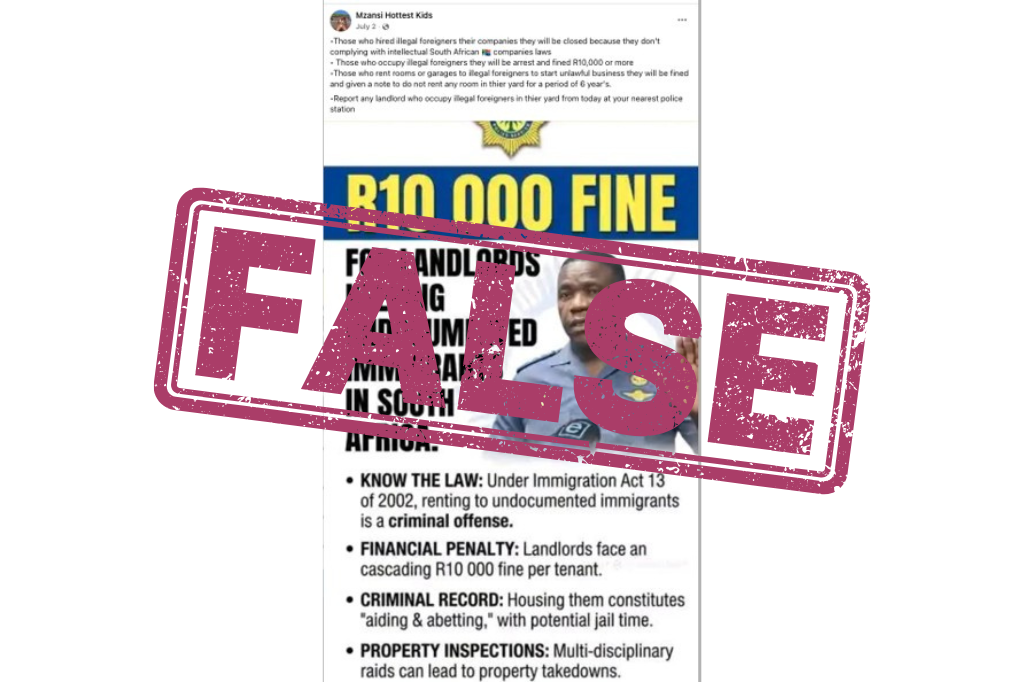
FALSE: Fake SAPS notice threatens landlords with R10,000 fine for housing migrants
by Mophethi Mabeba
- SAPS confirms that the “R10,000 landlord fine” notice circulating on social media never came from them, and that no such law exists.
A graphic circulating widely on Facebook claims to be an official notice from the South African Police Service (SAPS), titled “For landlords keeping undocumented immigrants in South Africa.”

The post warns landlords that they may face a R10,000 fine per undocumented tenant, criminal prosecution for “aiding and abetting,” and property inspections that could shut buildings down. This post is fake.
SAPS directly denied issuing the notice, stating that the document “did not originate from SAPS” and urging the public to verify information through official channels before sharing it.
The first thing that gives the notice away is the link itself. It points to “www.saps.policeservice.ou,” and that domain does not exist. There’s no such thing as a “.ou” top-level domain anywhere on the internet. The actual SAPS website runs on “.gov.za,” the extension reserved for South African government sites only. No government department, agency, or state entity can operate outside that domain, so any “official” notice living on a “.ou” address is dead on arrival.
AfricaCheck, a fact-checking organisation, also debunked the claim and found it to be fake.
There is also no law that matches what the graphic claims, which is that landlords face a cascading R10 000 fine per undocumented tenant, housing them constitutes “aiding & abetting,” with potential jail time and that multi-disciplinary raids can lead to property takedowns.
The fake notice cites the Immigration Act 13 of 2002 for legitimacy, but that Act doesn’t touch landlords at all. Its enforcement powers are aimed squarely at employers. The Act makes it an offence for anyone to knowingly employ an undocumented foreigner, and its Home Affairs and Labour inspectors, not police checking rental leases, enforce that through workplace inspections.
The R10,000 figure floating around in connection with this claim is actually an admission-of-guilt fine tied to that employer offence, not anything to do with renting out a room or a flat. Nothing in the Act creates a fine, criminal or otherwise, for landlords who house undocumented migrants.
A real bill, the Employment Services Amendment Bill, would raise fines to R100,000 for employers who are found to hire undocumented workers, but it remains before Parliament and, again, targets employers rather than landlords. The notice fuses these two unrelated, employer-focused facts into a landlord-specific threat that has no basis in law.
The post dropped into the country’s heightened tension around the 30 June anti-immigration “deadline” pushed by groups like Operation Dudula and March and March, and it spread fast enough to cause real damage before the correction caught up.
News24 reported that Isaac Nota, a Malawian tenant in Gugulethu, was told to leave his home, where he stayed for two years, after his landlord cited the fake notice’s R10,000 fine as the reason for evicting him.
The notice is false because it invents a legal consequence that does not exist, and it has already been used to justify evicting someone.
Verdict: False
Sources:
- https://iol.co.za/news/politics/2026-06-30-saps-debunks-fake-notice-claiming-r10000-fines-for-landlords-housing-migrants/
- https://africacheck.org/fact-checks/meta-programme-fact-checks/south-africa-ignore-fake-warning-against-renting-immigrants
- https://www.news24.com/southafrica/news/landlord-told-us-to-leave-fake-eviction-notice-fuels-panic-as-immigrants-try-to-flee-20260701-1149
This fact-check was produced by Centre for Information Integrity in Africa as part of the African Fact-Checking Alliance’s (AFCA) incubation programme. It was produced with peer-mentorship from Code for Africa’s fact-checking initiative, PesaCheck, with financial support from Norway Democracy. AFCA mentorship respects the journalistic independence of the researchers, offering access to advanced techniques and tools. Editorial decision-making remains with Centre for Information Integrity in Africa. Want to learn more? Visit: https://factcheck.africa/

