CINIA convenes IDRC partner’s summit to strengthen information integrity in the Global South
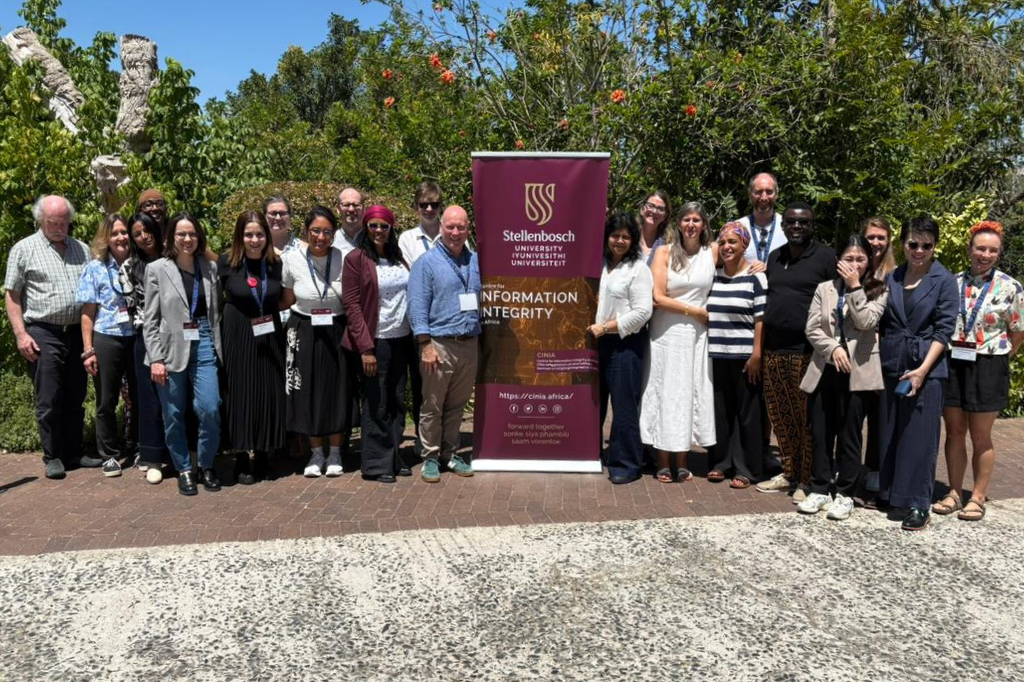
The challenge of building an inclusive, just, equitable, enabling and safe information ecosystem was the focus of a recent week-long planning workshop in Stellenbosch, hosted by the Centre for Information Integrity in Africa (CINIA). The workshop marked the start of a three-year research collaboration to strengthen information integrity in the Global South, funded by the Canadian International Development Research Centre (IDRC).
Representatives from IDRC partner organisations across Africa, the Middle East and North Africa (MENA), Latin America, and Asia convened to chart the project’s course and collaboratively design a research agenda.
Over the next three years, research organisations, practitioners, and activists will collaborate on projects addressing issues such as disinformation, media literacy, technology-facilitated gender-based violence (TGBV), investigative journalism and the responsible use of generative AI.
The Principal Investigator for the collaboration is Professor Herman Wasserman, CINIA Director and Professor of Journalism at Stellenbosch University, who will lead a core CINIA team overseeing the initiative. The goal of the project is to promote multidisciplinary and innovative research, stakeholder collaboration, policy advocacy, and capacity building across the Global South.
Prof Wasserman explains the purpose of the gathering. “The meeting brought together a wide range of stakeholders, such as civil society activists, researchers and academics from around the Global South. The idea was to hear what different organisations are doing and for CINIA to think about how we can bring this project forward with the ultimate aims of deepening knowledge and making an impact on policy.”
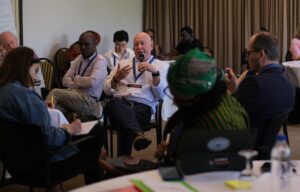
CINIA Director Prof. Herman Wasserman participates in a fish-bowl exercise aimed at exploring the definition of ‘information integrity’ at the IDRC-CINIA Partner’s Summit. Photo: Youlendree Apasamy.
Participants engaged in discussions on issues such as defining information integrity, producing impactful research, and communicating research outcomes. They also presented their current work and identified gaps that future research could address.
Participants saw the benefits of the gathering in strengthening networks and finding collaborative opportunities. ‘Gbenga Sesan, Executive Director of Paradigm Initiative, an African digital rights non-profit organisation headquartered in Lagos, Nigeria, highlighted the benefits of the gathering: “I had the privilege of listening to other organisations that work on both similar and different projects. It is interesting to see how we can collaborate and work together to advance the field of information integrity and get outcomes we can use on our advocacy work in this area.”
Dr Melissa Omino, Director of the Centre for Intellectual Property and Information Technology Law (CIPIT), at Strathmore University, Kenya, explained the importance of exploring various research methodologies. “The conference helped us understand different methodologies and how we can harness these for the great good of the network. It was interesting to see that everyone is using mixed methodologies in their work, but coming up with different findings and outcomes, depending on their localities. So that’s a ‘yay’ for local context, which I love to focus on!”
Following the conference, the CINIA team will synthesise the learnings from the five-day event, providing the foundation for partner organisations to submit research proposals under the broader umbrella of strengthening information integrity in the Global South.
Prof Wasserman explains, “CINIA will develop key research themes and then go back to these partners in the network and ask them to come up with concrete proposals they can work on. We will then help facilitate, fund and amplify these collaborative projects throughout the next three years.”